IRS Cracking Down on Reporting of Foreign Bank Accounts

The IRS is cracking down on U.S. persons who do not report their foreign financial accounts abroad.  A U.S. taxpayer having an ownership interest in a foreign account must file with the IRS a Report of Foreign Bank and Financial Accounts (FBAR) and IRS Form 8938, Statement of Specified Financial Assets, if the reporting threshold is met.  Both the FBAR and Form 8938 are informational returns to help the IRS identify persons who may be using foreign accounts to circumvent tax payment.

The FBAR must be filed by a U.S. person having a financial interest in or signature authority over at least one foreign account, and the aggregate value of all foreign accounts in which he has such an interest exceeds $10,000 at any time during the tax reporting year.  The FBAR does not have to be filed with the income tax return, and its deadline is on June 30th of the year following the reporting year.

IRS Form 8938 is a new IRS reporting form required in the 2011 tax reporting year and all future years.  The form must be filed if a U.S. person has a foreign financial account that contains at least $50,000 on the last day of the tax year or $75,000 at any time during the tax year.  Form 8938 must be filed with the income tax return or by the extension of the income tax return.

Harsh civil and criminal penalties apply to U.S. persons who have not filed these forms nor have paid taxes on foreign accounts.  The Offshore Voluntary Disclosure Program is being offered by the IRS to allow U.S. persons who have not reported income from foreign accounts to now disclose such accounts, amend past tax returns, and become current on their taxes.  Those taxpayers who choose to enter the program are subject to reduced penalties than had the taxpayer not voluntary disclosed.  The program has a look back period of eight tax years from which the tax reporting due date has already passed.  Although the IRS offers reduced penalties and interest for those who are accepted into program by the IRS, significant costs do exist to the taxpayer.  The IRS has reportedly collected $5 billion in back taxes, interest and penalties from 33,000 voluntary disclosures made under its first two programs in 2009 and 2011 alone.  The IRS has open ended its 2012 program as a result of its success.

Further incentive to enter the Offshore Voluntary Disclosure Program is the Foreign Account Tax Compliance Act (FATCA) which became effective on December 12, 2012.  Under this law, non-U.S. foreign financial institutions (and certain non-financial entities) must identify and disclose their U.S. account holders and members, or otherwise become subject to a 30% U.S. withholding tax on any payment of U.S. source income and proceeds from the sale of equity or debt instruments of U.S. issuers.  A foreign entity with whom a taxpayer has an account may therefore report the taxpayer to avoid this tax without the taxpayer’s consent or knowledge.  At that point, the taxpayer will become subject to severe tax penalties, criminal and civil charges and may no longer have the opportunity to enter into the IRS voluntary disclosure program.

For more information on the Offshore Voluntary Disclosure Program or any other matter in this article, please do not hesitate to contact Burke Costanza & Carberry LLP.

New I-9 Forms

For the first time in many years, the I-9 form has received substantive changes to both content and layout.  The United States Department of Homeland Security announced that a new I-9 Form is available for immediate use by employers. 

Am I required to fill out I-9 forms for my employees?
All employers are required to fill out I-9 forms regardless of their size or industry. 

Are there any exceptions for small employers or specific industries?
No.  All employers are required to complete I-9 forms for all employees.

Where can I locate the new I-9 forms?
New I-9 forms can be found here along with information regarding the forms and changes.

Do we have to use the new I-9 Form?
While all employers may use the new I-9 forms immediately, they are not required to do so until May 7, 2013.  As of May 7, 2013, employers who fail to use the new forms may be subject to civil money penalties. 

What are the main changes?
While none of the changes will cause major change in an employer's current policies or practices, the new I-9 Form has been expanded from one page to two pages and includes expanded instructions.  In addition, the new form includes fields for an e-mail address, phone number, and foreign passport in Section 1. 

What should I do if I haven't filled out I-9 forms for my employees, or if we have kept I-9s but have not completed them correctly?
If your company has not complied with I-9 requirements, you should immediately consult with your attorney to determine the best way to come into compliance and implement compliant policies for future compliance. 

Should I copy an employee's identification?
The I-9 instructions do not mandate that an employer should or should not keep copies of an employee's identification.  However, an employer should make sure that it implements a uniform policy.  In other words, if an employer wishes to keep copies of employee documents, then it should keep copies of employee documents for all employees, not just some employees. 

How long do I need to retain copies of I-9 forms?
Employers must retain copies of I-9 forms for either three years, or one year after termination of the employee, whichever is longest.  In other words, if you have an employee who works for you for one year, you must keep the I-9 for at least three total years.  But if you have an employee who works for you for ten years, you must keep the I-9 for eleven years (one year after termination of the employee). 

What are the penalties if I fail to keep I-9s?
Employers may be subject to a variety of fines and penalties if they fail to correctly fill out and keep I-9 forms.  These fines and penalties ranges from $110.00 to $13,500.00 depending on the type of violation, whether the employer is a repeat offender, and other factors. 

Action Items:
Moving forward, employers should:

  1. Review their current policies relating to I-9 forms to ensure that are implemented in a uniform and non-discriminatory manner;
  2. Begin using the new I-9 forms immediately; and
  3. Should consult with an attorney if the employer finds non-compliant practices in past practices to ensure future compliance.

Please contact us if you have questions or concerns regarding the foregoing matters.

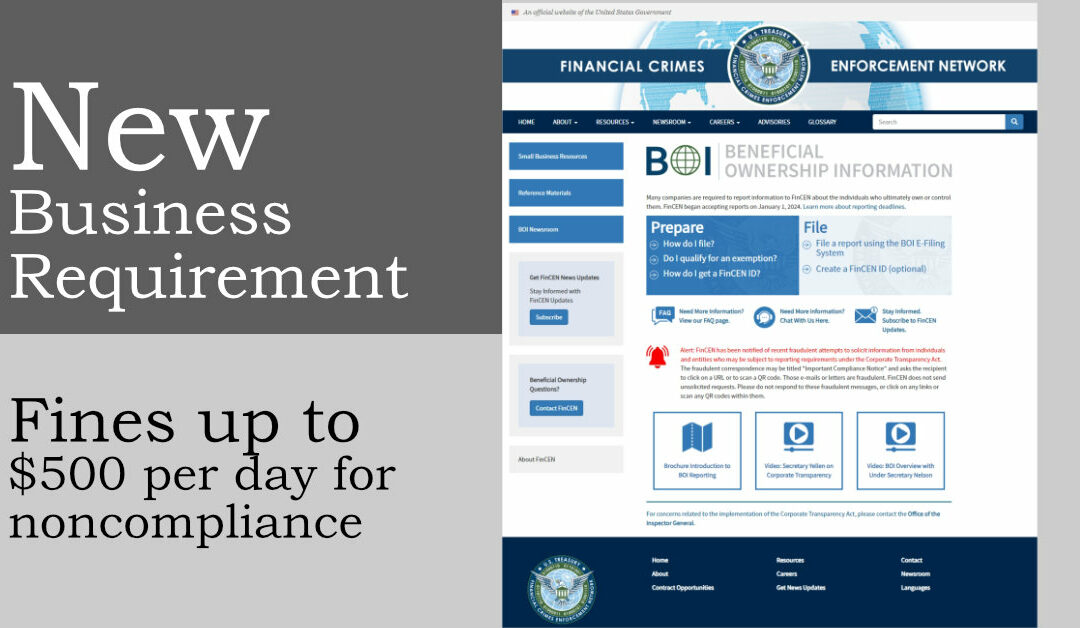
Business Owners Beware of Fraudulant Compliance Requests

Business owners beware.  The Indiana Secretary of State Business Services Division has issued a scam alert arising from fraudulent compliance requests being sent from an unknown source to Hoosier businesses.  Many businesses have reported receiving a deceptive letter that appears to come from an official government source.  The mailing includes a letter and a form to record the company’s annual minutes with a fee of $125.  It gives the appearance of coming from a legitimate government agency and cites state law.

BCC attorneys have reviewed several of these fraudulent letters received by their clients and find that all letters so far come from “Corporate Records Services.”  They include a return response date to give the impression that prompt action is necessary. It may look something like this:

Please be on notice that this letter is not an official letter from the Indiana Secretary of State Business Division or any other Indiana state agency.  Feel free to disregard this correspondence, or report it to the Indiana Secretary of State Business Services Division at (317) 232-6576. 

Some red flags to consider when receiving correspondence that may appear to be official:

  • Does the official seal or name of the government agency appear to be the same as that on the government agency’s online website?
  • Is the form received available on the government agency’s website and are the fees the same as those stated online?
  • Is the form’s return address the same as the address of the government agency?

If you may have any doubt regarding an official letter or document received, please do not hesitate to call one of our attorneys to review the legitimacy of the correspondence.

Can You Be Liable For Your Parent's Nursing Home Bills?

Filial Responsibility

I. Introduction

Filial responsibility laws purport to obligate adult children to financially assist their parents if the parents are indigent or financially unable to pay their bills for life’s necessities. Depending on the parent’s state of residence, these laws in varying degrees can be used by nursing homes and other long term care facilities located in the states that have such laws as a means to seek reimbursement for unpaid bills. U.S. filial responsibility statutes were derived from England’s Elizabethan Poor Relief Act of 1601, which required the grandparents, parents, and children of every poor, blind, lame and impotent person to financially support that individual if they were able to do so.

Currently, 29 states have filial responsibility statutes that establish a duty for adult children to care for their indigent parents. Some of these states even make it a crime to violate the civil statute. The civil statutes may compel adult children to reimburse state programs or institutions that have cared for their indigent parent with either a single contribution or through installment payments. Twenty-one states allow for civil court action, twelve allow for a criminal penalty, and three allow for both to obtain financial support. However, many filial responsibility laws limit children’s liability under a variety of conditions.

In the past, filial responsibility laws have rarely been enforced. Since the 1960s, federal law 42 U.S.C. § 1396(a)(17)(D) has prevented states from considering the financial responsibility of any individual (except a spouse) in determining the eligibility of an applicant or recipient of Medicaid or other poverty programs. Federal and state laws permit Medicaid to seek reimbursement from recipients’ estates. However, an increasing number of recipients are hiding their financial assets to meet Medicaid’s standards. Some seniors transfer their ownership assets to their children through trusts to become Medicaid eligible without risking their children’s inheritance. While the recipients’ children receive the benefits of these assets, taxpayers are left to pay for their parents’ care. To discourage these plans, federal law now allows states to count assets that were transferred to children within three years of the Medicaid application. However, with many states running deficits and looking for additional funds, it appears that this is a developing issue. Recent articles in the New York Times, Wall Street Journal and Forbes Magazine have discussed this issue.

II. Most Recent Case- Health Care & Retirement Corporation of America v. Pittas

In the most recent case involving filial responsibility, Health Care & Ret. Corp. of Am. v. Pittas, the son was found liable for his mother’s $93,000 nursing home bill. Health Care & Ret. Corp. of Am v. Pittas, 2012 Pa. Super. 96, 2012, Pa. Super. LEXIS 537, at *1 (Pa. Super. Ct. 2012). His mother was treated at a skilled nursing facility for injuries sustained during an automobile accident. Id. In March of 2008, his mother withdrew from the facility and moved to Greece. Id. She left a large portion of her bills unpaid. Id. at *2. As a result, the facility instituted a filial support action pursuant to 23 Pa.C.S.A. § 4603 against the son. Id. Pursuant to the statute, the spouse, child or parent had the responsibility to care for and maintain or financially assist the indigent person unless the individual did not have sufficient financial ability or if the parent abandoned the child for a period of ten years during the child’s minority. Id. at *4.

First, the Court found that the son had sufficient financial ability to support his mother. Id. at *5. The son failed to provide sufficient documentation as to all of his finances, income, expenses, assets and liabilities. Id. Second, the Court held that it did not have to consider other sources of income, such as his mother’s husband or her other two adult children. Id. at *9. Nothing in the statute required the Court to consider other sources of income. Id.  If the son had wanted to share his burden of supporting his mother, he was permitted to join those individuals in the beginning of the case. Id. at *10. Last, the Court held that an indigent person did not need to be completely destitute. Id. at *11.  The term “indigent persons” encompassed persons who had some limited means, but not sufficient to adequately provide for their own maintenance and support. Id.

III. Indiana’s Filial Responsibility Statutes

Any individual whose parent provided the individual with necessary food, shelter, clothing, medical attention and education until the individual reached 16-years-old and who is financially able due to the individual’s own property, income or earning shall contribute to the support of the individual’s parents if either parent is financially unable to provide his own necessary food, clothing, shelter and medical attention. IND. CODE ANN. § 31-16-17-1 (1) (West 1997). An action for support may be instituted against a child for violating the duty to support his parent by filing a verified complaint in a circuit or superior court in the parent’s residential county. IND. CODE ANN. § 31-16-17-1(2) (West 1997). An individual who knowingly or intentionally fails to provide support to his parent, when the parent is unable to support himself, commits nonsupport of a parent, which is a Class A misdemeanor. IND. CODE ANN. § 35-46-1-7 (West 1998). It is a defense if the accused had not been supported by the parent during the time he was a dependent under 18-years-old, unless the parent was unable to provide support. Id. It is also a defense if the accused was unable to provide support. Id.

IV. Indiana Case Law

A.  Pickett v. Pickett

The appeal arose from a decision imposing a duty to support appellant’s mother pursuant to Burns Ind. Stat. Anno., Sect. 3-3001 which read: “Any person being over twenty-one years of age and who is financially able by reason of his or her property, income or earnings, and who has been provided with necessary food, shelter, clothing, medical attention, and education until he was sixteen years of age, if a male, or seventeen years of age if a female, by his or her father or mother, shall have the legal civil duty to contribute to the support of his or her parent or parents having so furnished such food, shelter, clothing, medical attention and education, if such parent or parents be financially unable to furnish themselves with necessary food, clothing, shelter and medical attention.” Pickett v. Pickett, 251 N.E.2d 684, 685 (Ind. Ct. App. 1969).

The son was the only child born to his parents. Id. His parents obtained a divorce, and the custody of the son was granted to the father. Id. at 686. The son ’s father died leaving an estate of $238,000 to the son. Id. The son also owned several properties. Id. The mother remarried and divorced. Id. Upon hearing the death of her first husband, she moved back to Evansville and began moving from the home of one relative to another. Id. In the mother’s complaint, she alleged that she was destitute and in need of care and that she had provided for her son until he had reached sixteen years of age. Id. She also alleged that her son had the financial ability to support her. Id.

The court believed that the intent of the General Assembly was to relieve the general public of liability for support of those individuals who had children financially able to contribute to their maintenance and support.  Id. at 687. Financial ability must be determined by the individual circumstances present in the case. Id. The court held that there was enough evidence to properly find that the mother was entitled to support contributions from her son. Id. at 688.

B. Davis v. State

The mother was a widow and had been struck by an automobile. Davis v. State, 240 N.E.2 d 54 (Ind. 1968). She was seriously injured and was in a nursing home. Id. After the accident, she became depressed. Id. Her home and property were liquidated to pay for her medical, hospital and nursing home expenses. Id. She had three sons and six daughters. Id. All of the daughters contributed to the financial support of their mother; however, they could not get their two brothers to contribute.  Id. Thereafter, one of the sons was convicted and ordered to pay $7.00 per week for the support of his mother. Id. The son appealed and contended that there was no proof that he was financially able to support his mother. Id.
The Court held that the State had failed to show that the son, even though gainfully employed, was financially able to support his parents or anyone. Id. at 56. Although he was employed, the income was not sufficient for any surplus over and above the necessary for his own support and his family’s support. Id.

C. Lanham v. State

This case involved a criminal action against adult children, who were financially able but failed to maintain and support their father without reasonable cause. Lanham v. State, 194 N.E. 625, 626 (Ind. 1935). The father was sick and unable to work. Id. The trial court found the children guilty and fined each of them. Id. The children appealed. Id. The statute stated that if the child willfully refused to care for his parent who was physically and financially unable to care for himself and the child was financially able to do so, the child was guilty of a misdemeanor. Id. The statute excluded all adult children who had not lived with or who had not been supported by their parents when they were minors. Id. The evidence showed that the father had made no effort to maintain a home for his children when they were minors. Id. at 627. The father paid child support from 1919 to 1926, but it was not enough to provide the children with even the barest accommodations. Id.  The mother was only able to keep the family together through the two eldest sons’ earnings. Id. The Court held that children were not supported by a father who had abandoned his family and whose forced contributions to support them were inadequate to furnish the necessaries of life, including an education. Id. The judgment was reversed. Id.

For more information on Filial Responsibility please contact Tory Prasco.

Update on Estate and Financial Planning Before and After December 31, 2012

On December 17, 2010, President Obama signed into law the “Tax Relief, Unemployment Insurance Reauthorization and Job Creation Act of 2010.”  It increased the federal estate tax exemption to $5,000,000 effective January 1, 2011.  Unfortunately, this window of time with a large exemption may close on December 31, 2012.  The purpose of this memorandum is for you to consider the anticipated changes in the laws and your personal circumstances to determine if you should make any changes to your estate or financial plan before the end of the year.

Background:  The modern estate tax dates back to 1916, when it was imposed at a rate of 10% on the portion of estates above $50,000.  In considering a bill in 1917 that would have doubled rates to a top rate of 20%, the Senate Finance Committee said:

Such a tax, when used as an emergency measure, is necessarily unequal in operation.  Only if continued at the same rate for many years – the period of a generation – does it become equal for all persons in like situation.  If levied as a war tax, that is, as a temporary emergency measure, it falls only upon the estates of those who happen to die during the period of the emergency.

Unfortunately, the federal estate tax has been a moving target for at least ten years, and it appears that it may continue to be a moving target for at least the next several years.  However, this time there are several different taxes that are also affected.  This often times makes planning difficult.

In 2001, Congress passed the first of two large legislative packages that contain most of what are now commonly referred to as the “Bush Tax Cuts.”  These tax cuts lowered the income tax rates, capital gains tax rates and estate and gift tax rates.  If Congress takes no action before the end of the year, you will generally pay higher tax rates on your wages, dividends, interest and capital gains.  In addition, the new 3.8% Medicare tax will generally be imposed on unearned income beginning on January 1, 2013.  Therefore, if you have the ability to recognize income in 2012 or 2013 (e.g., wages or dividends in your small business or the sale of a highly appreciated asset resulting in a capital gain such as stock or real estate), it may be beneficial from a tax standpoint to recognize the income in 2012.

With respect to the federal estate and gift tax, the 2001 tax law gradually lowered the maximum estate tax rate and substantially raised the federal estate tax exemption (also known as the applicable exclusion amount) over the years 2002 through 2009 ($675,000 in 2001; $1,000,000 in 2002 and 2003; $1,500,000 in 2004 and 2005; $2,000,000 in 2006 through 2008; $3,500,000 in 2009; no estate tax in 2010).  The maximum tax rate fell from 60% under prior law in 2001 to 45% in 2007 through 2009.

The 2001 law also repealed the estate tax completely for decedents dying in 2010.  This led to several well-publicized instances in which famous people (including George Steinbrenner) who died in 2010 leaving multi-billion dollar estates that passed to their heirs without paying a penny in federal estate tax.  However, all of those provisions were scheduled to sunset on December 31, 2010, meaning that if Congress had not acted prior to that date, the estate tax would have sprung back to 2001 levels of a $1,000,000 applicable exemption amount.  Now, almost two years later, we unfortunately find ourselves in about the same situation.

New Law:  Under the 2010 law, the exemption increased to $5,000,000 for 2011 with a further increase for inflation in 2012 ($5,120,000).  It also reduced the top tax rate to 35%.  However, these changes are only temporary.  Effective January 1, 2013, the top tax rate will increase to 55% and the exemption amount will be reduced to $1,000,000 again, unless Congress takes action.

Based upon the $5,000,000 exemption, it was estimated that the vast majority of estates (all but an estimated 3,500 nationwide in 2011) would not be subject to any federal estate tax and the revenue raised from the estate tax in 2011 was estimated to be about $11.4 billion.  However, if the exemption amount had been instead reduced to $1,000,000 in 2011 with a top tax rate of 55%, it is estimated that there would have been 43,540 taxable estates in 2011 (a more than twelve-fold increase), which would have raised approximately $34.4 billion in tax revenue.

The 2010 law also gave heirs of decedents dying in 2010 a choice of which estate tax rules to apply, the 2010 rules (that provide for no estate tax and carry over basis) or the 2011 rules (which provide for a $5,000,000 exemption).  Since there was no estate tax in 2010, some inherited assets were subject to higher capital gains taxes under the 2010 rules, a situation that could actually increase the total tax burden for some heirs.  Inherited assets under the 2010 rules have a tax basis equal to the price when they were purchased (often referred to as carryover basis) rather than the price at death (often referred to as stepped-up basis).  Under the 2011 rules, heirs were able to inherit assets with a stepped-up basis.  While most heirs would choose the 2011 tax rules, the heirs of very wealthy decedents occasionally found it more advantageous to elect the 2010 law.

For many years, the gift tax and the estate tax were unified which means that each tax shared a single exemption amount and were subject to the same rates.  This was not the case in recent years.  For example, in 2010, the top gift tax rate was 35% and the exemption was only $1,000,000.  However, for gifts made in 2011 and 2012, the gift tax was re-unified with the estate tax under the 2010 law, which means that the $5,000,000 ($5,120,000 in 2012) estate tax exemption will also be available for gifts – but only for gifts made in 2011 and 2012.

The 2010 law also introduced a new concept called “portability.”  This allows the use of an exemption amount in a pre-deceased spouse’s estate and the surviving spouse’s estate.  Prior to portability, standard estate planning for wealthy married individuals included the use of a “family trust” or “credit shelter trust” to take advantage of the exemption amount of the first spouse to die.  Portability was trumpeted as a big win for the taxpayer so that these bypass-type of trusts were no longer necessary.  However, before abandoning the use of the bypass trust, be aware that this portability opportunity expires on December 31, 2012.  Even then, if the surviving spouse lives at least until 2013, there is some uncertainty as to how the portable amount of the exemption received from the deceased spouse will be treated in subsequent years.  Portability also does not apply to the generation-skipping tax.  There is also some asset protection planning opportunities and state death tax saving opportunities using a bypass trust.

What To Do:  We recommend that clients review their estate plans periodically and/or whenever a significant life event occurs (e.g., birth of a child, death of a spouse, purchase of new home, significant increase in wealth, etc.).  However, changing laws should also cause all clients to consider reviewing their estate plans.

For clients with substantial amounts of wealth or with valuable closely held businesses, we recommend that such clients consider using lifetime gifts in 2012 to take advantage of the $5,120,000 lifetime gift tax applicable exclusion amount because this valuable tool is scheduled to expire on December 31, 2012 if Congress does not take any action.  If a large gift is made in 2012, the law is not clear whether the large gift will be pulled back into your taxable estate if you die in a year in which the exemption amount is much less.  This is sometimes called “the clawback” possibility; however, most commentators agree that this is an unlikely scenario.

It is possible that Congress may take action before the end of this year and extend $5,120,000 gift and estate tax exemptions for some period of time.  It is also possible that Congress may take action but reduce the exemption to something between $1,000,000 and $5,120,000 – $3,500,000 has been included in some proposed legislation in the last two years.  Remember, it was December 17th the last time Congress took action regarding estate tax reform.

Finally, we want to remind you that the annual gift exclusion (currently $13,000) is separate from the lifetime annual exclusion we discussed above.  The annual gift exclusion is still available and is not affected by these changes.  In fact, it is projected by several commentators that the exclusion amount may increase in 2013 to $14,000 per donee (it is indexed for inflation) but we will not know the exact amount until January 2013.

We recognize that it is difficult to plan when the law is continually changing and there is no way to predict how or when Congress will act. Please do not hesitate to contact us with any questions that you might have or if you would like to discuss your estate plan.

For more information please contact Tory Prasco via email or call 219-769-1313.